
A managed cluster is for teams running multiple applications and environments. Running a single application that needs to be looked after? A CaffeineStack from €300/month is the better start.
Self-managed from €100 · managed for you from €300 · your own platform from €2,500.
We deliver Talos-based dual-cluster setups (staging and production) on a predictable monthly invoice. The package covers GitOps automation, observability, backups, and incident response, with a 99.9% monthly SLA. The Advanced service level is part of the cluster base: for P1 incidents on production we also respond outside office hours.
Is Kubernetes right for you?
A dedicated cluster suits multiple container applications whose deployments, networking and capacity you want to manage together. Kubernetes provides auto-scaling, rolling updates and service discovery for that purpose.
For a smaller environment with one or two apps, Managed Servers from €300/month are often sufficient.
Want Kubernetes benefits without running a cluster? Pods from €100/month gives you a namespace on our managed cluster.
What you get
From €2,500/month you get a complete dual-cluster setup. Setup is a one-time €2,500: architecture session, cluster build, migration support, monitoring and backup onboarding, and a documented recovery test with runbook. Cancel monthly, no minimum term.
| Cluster | Nodes | Purpose |
|---|---|---|
| Staging | 3× control plane 3× workers |
Updates and changes are tested here first |
| Production | 3× control plane 3× workers |
Where your production workloads run |
The cluster base includes 72 vCPU, 176 GB of memory, 2 TB of NVMe, and 2 TB of SAS/SATA storage, both with redundancy and backups included.
We absorb temporary spikes. The base grows with you; structural expansion is planned together.
What "managed" means here
When comparing managed Kubernetes services, check the scope of operations. A control-plane-only service leaves worker nodes, ingress, TLS, monitoring and backups with your team. Check which tasks and incidents each provider takes responsibility for.
We draw the line a few layers higher:
| Layer | Control-plane-only providers | CoffeeSprout Managed Cluster |
|---|---|---|
| Control plane | Managed | Managed |
| Worker nodes | You patch, upgrade, and scale | We patch, upgrade, and scale |
| Platform (ingress, TLS, monitoring, backups) | Build and maintain it yourself | Included, managed by us |
| Incidents | Your pager | We respond; for P1 incidents on production also outside office hours |
Our price includes management of these platform components, with the agreed incident response times.
Without Kubernetes, too
The same dedicated platform also comes as a managed VM environment on Proxmox. Same base capacity (72 vCPU, 176 GB of memory, 2 TB of NVMe, and 2 TB of SAS/SATA storage), same Advanced service level, same price and setup. Only the shape differs: virtual machines instead of containers.
Kubernetes is the default for container-native teams. The VM variant fits estates that run on virtual machines: CI runners, GitLab, legacy services, or mixed workloads. Which shape fits your platform is something we settle together in the architecture session.
Pricing and terms
Alongside computing capacity, compare the costs of operations, network traffic and load balancing. Our pricing includes:
- Fixed monthly price: from €2,500/month for your dual-cluster foundation, Advanced service level and support included.
- One-time setup: €2,500 for the architecture session, cluster build, migration support, monitoring and backup onboarding, and a documented recovery test with runbook.
- Load balancer and traffic included: 2 TB of NVMe and 2 TB of SAS/SATA storage come with the cluster base. Expansion at published prices: NVMe €25 per 100 GB, SAS/SATA storage €15 per 100 GB.
- No minimum term: Cancel monthly, one month's notice. We hold ourselves to three months. If your environment needs hardware we buy specifically for it, we agree a term for that up front.
- Work outside scope: A fixed price per job, up front, based on our €120 hourly rate. You know the amount before we start.
How it works
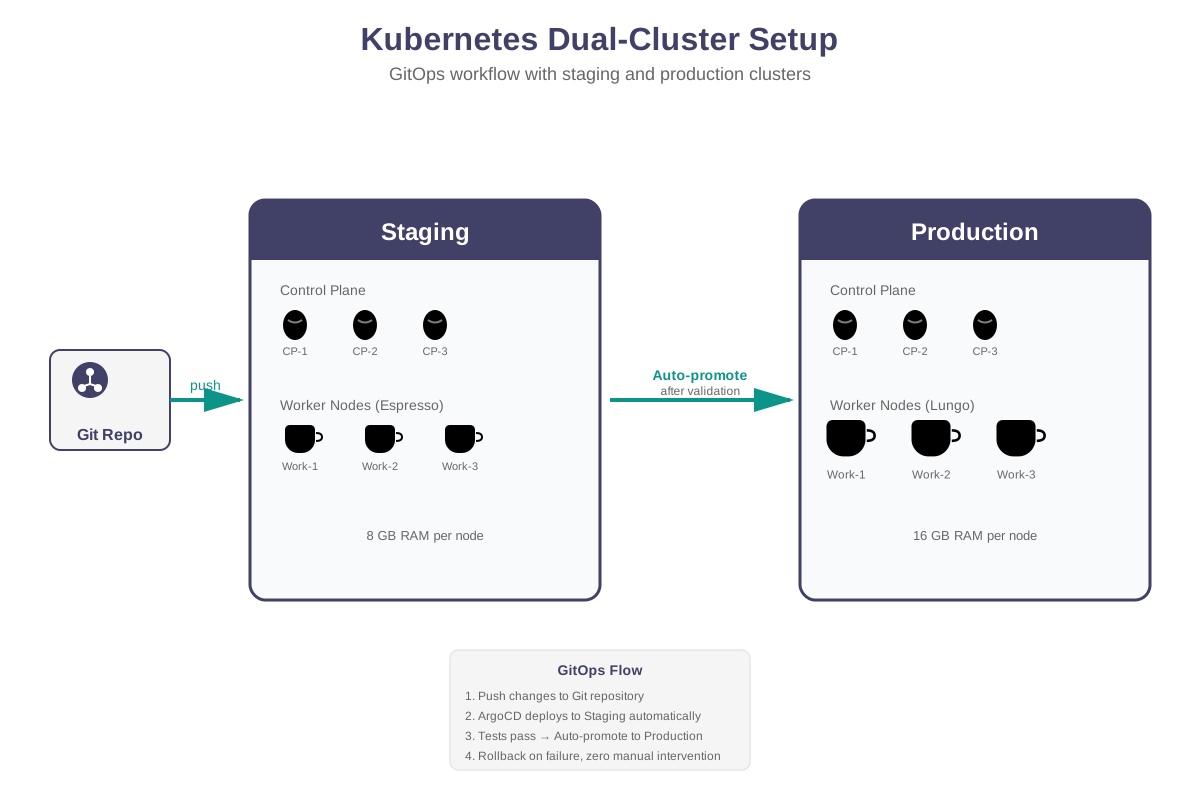
Staging and production: Staging runs the same configuration, versions and workloads as production. We test updates there first. Once staging is stable, we roll out to production; the testing window depends on the impact of the change.
GitOps: Your infrastructure and deployments live in Git. We use Argo CD for automated rollouts. Every change is traceable, every deploy is repeatable.
Monitoring & observability: Prometheus, Grafana, and OpenTelemetry built in. You see what's running, where resources go, and where bottlenecks are. Dashboards for your team, alerts to whoever you want.
Support and management: We upgrade Kubernetes, patch nodes, monitor cluster health, and are there when something goes wrong. Advanced is part of the cluster base: for P1 incidents on production we also respond outside office hours. Routine requests are handled within a working day.
Why these technical choices?
Talos Linux: We use Talos as the OS for Kubernetes nodes. Talos is immutable, API-driven, and secure by default. Built specifically for Kubernetes without legacy OS baggage. That means smaller attack surface, predictable updates, and no manual SSH sessions.
Minimum cluster sizing: 3 control plane nodes and 3 worker nodes is the minimum viable HA setup. Add more workers as workload grows.
What else is included
- Managed ingress & TLS: Certificate management, SSL termination, and routing to your services. Automatic cert renewal via Let's Encrypt or your own CA.
- Secure access: VPN or dedicated circuits to your cluster. RBAC configured, identity integration via Keycloak, and signed container pipelines.
- Disaster recovery: Backup strategies and tested recovery procedures, with runbooks for blue/green and canary releases. The measured recovery times are below, under Continuity.
- Capacity planning: Quarterly reviews with buffer for seasonal peaks.
- CI/CD integration: Buildpacks, Maven/Gradle pipelines, and artifact signing. We help integrate your pipeline with GitOps.
Continuity
- Remote recovery, included: Backups run twice a day and are automatically verified. Recovery is measured, not estimated: a full cluster restore in 49 minutes, individual VMs in 1.5 to 6 minutes. Read how we measured this.
- Standby in a second Dutch location: Available for platforms that need to keep running when a datacenter fails. We test failover at least once a year, and the test date goes in your annual report. The standby price depends on your environment; you get it up front as a fixed monthly amount.
- Fully dual-location: Your platform active in two locations, available as an option.
Java advantages
Java is where we're at home, so you get extras:
- JDK base images: Curated images with Temurin and OpenJDK. Automatic updates, triggered rollouts, tested in staging first.
- JVM tuning: Liveness checks and auto-scaling profiles tailored to Spring Boot, Quarkus, and Jakarta EE.
- Observability: JVM metrics, request traces, and log correlation. Dashboards with heap usage, GC stats, and thread dumps ready to go.
Who is this for?
Java teams without an SRE department: You want Kubernetes but not the hassle of cluster management. We run the infrastructure, you build features.
Agencies with multiple clients: One cluster for all your Java projects, with namespace isolation. Building for clients? See how we work with shops.
Scale-ups outgrowing simple setups: You've outgrown managed servers but don't want to hire an SRE team yet. This is the middle ground.